
Event-triggered ϵ-PID Control of a DC Motor

Copyright© ICROS 2025
Abstract
In this study, an event-triggered ϵ-PID controller has been proposed for controlling the position of a DC motor. An event-triggering condition with a pre-defined positive constant T was designed by modifying the framework of the event-triggered control method to prevent the Zeno behavior. The controlled system was analyzed using the Lyapunov and Razumikhin stability theorems. For comparison, simulation results have also been provided that further highlight and confirm the merit of the proposed control method over the conventional time-triggered control technique.
Keywords:
DC motor, event-triggered control, ϵ-PID controlI. INTRODUCTION
In [1], an ϵ-PID controller is suggested for the position control of a DC motor where the gain-scaling parameter 𝜖 is effectively used in tuning control parameters for adjusting control performance. On the other hand, there have been a number of results on event-triggered control methods where the main merit is the efficient usage of communication resources due to the discretely updated control inputs. In [2], the design of event-triggered non-fragile dynamic output feedback controllers for linear systems facing actuator saturation and disturbances is addressed, incorporating additive gain variations. In [3], they introduce a control-based event-triggered sliding mode control for networked linear systems, focusing on triggering events based on deviations in control input rather than system states. In [4], various event-triggered schemes, including sampling and communication methods, are addressed. This paper explores four key models for event-triggered control systems and summarizes methods for stability analysis and controller design. In [5], the conditions for achieving consensus both with and without external disturbances are established, ensuring that Zeno behavior is avoided. In [6], an input-to-state stability property for the closed-loop system is established through cooperative systems theory. The proposed method is demonstrated through its application to a gyroscopic control problem in marine robotics for curve tracking dynamics. In [7], they derive LMI-based conditions for computing controller and observer gains. In addition, as a study on DC motor control, the paper [12] proposed a recurrent neural network-based inverse model controller and applied it to the current controller of a DC motor coupled with a reducer.
Note that the event-triggered control methods have certain merits as mentioned above, yet at the same time, they have some disadvantages such as complicated analysis related with triggering conditions and somewhat difficult implementation due to memory requirement [11]. In this regard, in [8], a zero-order-hold (ZOH) based event-triggered control (ETC) method is proposed where its merits lie in two aspects: simplified system analysis regarding the Zeno behavior and even less number of control inputs updates compared to the traditional event-triggered control methods.
In this paper, we newly suggest an event-triggered 𝜖-PID controller for the position control of a DC motor by following the ZOH-based ETC method of [8] where the merit of using gain-scaling parameter ϵ still remains valid and there is an additional merit of using less control input updates due to intrinsic nature of the event-triggered control method. Moreover, due to the ZOH feature, the additional analysis regarding the Zeno behavior is not needed. With our proposed control scheme, we carry out the rigorous system analysis by utilizing both Lyapunov and Razumikhin theorem and show that the controlled system is well bounded whose ultimate bounds can be manipulated by using ϵ. Our controller is proposed for the position control of a DC motor where the gain-scaling parameter ϵ is utilized to fine-tune the control parameters allowing for adjustments in control performance over [6] and [8]. Then, we perform the numerical simulation in order to illustrate the merits of our proposed control method over the traditional time-triggered control method [1] by comparison.
II. SYSTEM AND PROBLEM FORMULATION
The dynamic equation of a (MAXON) DC motor is given by [1]
| (1) |
where 𝑞 is the position link, 𝐾𝑚 is the torque constant, 𝐽𝑚 is the motor inertia, 𝐵𝑚 is the damping coefficient, 𝐾𝑏 is the back emf constant, 𝑅 is the armature resistance, r is the fear ratio, 𝑤(𝑡) is the load torque, and 𝑢 is the control input in voltage.
Let 𝑥1 = 𝑞, 𝑥2 = , 𝑒1 = 𝑥1 − 𝑞𝑑, and 𝑒2 = 𝑥2 where 𝑞𝑑 is a piecewise constant signal. Then, the system (1) turns into
| (2) |
where
| (3) |
Thus, the considered system (2) represented in a state-space equation is a linear system with a nonvanishing disturbance signal. Considering the usual cases in practical applications, 𝑤(𝑡) is assumed to be finitely bounded for all 𝑡 ≥ 0. Our control goal is to design an event-triggered PID controller to make 𝑞 track a bounded signal 𝑞𝑑.
III. EVENT-TRIGGERED ϵ -PID CONTROLLER AND SYSTEM ANALYSIS
By adding an integrator as 0 = 𝑒1 to the system (2), we obtain a third-order system as
| (4) |
where 𝑒 = [𝑒0, 𝑒1, 𝑒2]𝑇 and (𝐴, 𝐵) is a Brunovsky canonical pair.
By considering (4), we can give a time-triggered 𝜖-PID controller [1] as
| (5) |
where
| (6) |
with 0 < ϵ < ∞ to be chosen.
By utilizing (5), we propose the following event-triggered 𝜖 -PID controller
| (7) |
with a triggering condition of
| (8) |
where 𝑡0 = 0, 𝑖 = 0,1, ⋯ , 𝐸ϵ = diag[1, 𝜖, 𝜖2], and the parameters 0 < σ, 𝑇 < 1 are to be chosen.
System Analysis: From (4) and (7), for 𝑡 ∈ [𝑡𝑖,𝑡𝑖+1), the closed-loop system is
| (9) |
where 𝐴𝐾(ϵ) = 𝐴 + 𝐵𝐾(ϵ) with 𝐾(ϵ) = [𝑘1/ϵ3, 𝑘2/ϵ2, 𝑘3/ϵ].
Here, we consider two cases as follows
Case 1. .
Following [1], by assuming that 𝐴𝐾 = 𝐴𝐾(1) is Hurwitz, we can use a Lyapunov equation of where 𝑃ϵ = 𝐸ϵ𝑃𝐸ϵ and . Then, with a Lyapunov function of 𝑉(𝑒) = 𝑒𝑇𝑃ϵ𝑒, along the trajectory of (9),
| (10) |
Note that, for 𝑡 ∈ [𝑡𝑖,𝑡𝑖+1), |𝑢 − 𝑢| ≤ 𝜎‖𝐸𝜖𝑒‖ and there exists a finite constant w̅ such that w(t) ≤ w̅ for all t ≥ 0. So, inserting these inequalities into (10), we have
| (11) |
From (11), we can see that when we select σ and ϵ such that 1 − 4𝑏‖𝑃‖𝜖3𝜎 > 0, ‖𝐸𝜖𝑒‖ is ultimately bounded by O(ϵ3) [9], which means that the ultimate bound of ‖𝑒‖ becomes smaller as ϵ decreases.
Case 2. .
In this case, we need to investigate the upper bound of u − u̅ differently from Case 1. First, we have
| (12) |
Here, note that
| (13) |
| (14) |
By inserting (13) and (14) into (12), we can derive the inequality as follows.
| (15) |
Where .
We use a Razumikhin theorem [10] to deal with a term ‖𝐸𝜖𝑒𝑡‖.
Thus, from 𝑉(𝑒𝑡) < 𝑞𝑉(𝑒), 𝑞 > 1, we can obtain that ‖𝐸𝜖𝑒𝑡‖ < 𝑞‖𝐸𝜖𝑒‖ where . Thus, (15) becomes
| (16) |
Where
| (17) |
| (18) |
Now, from (10) and (16), noting that ‖𝐸𝜖𝐵‖ = ϵ2, it is easy to get
| (19) |
From (19), we can see that when we select ϵ and T such that 1 − 4𝑏‖𝑃‖𝜖2𝛥1(𝜖, 𝑇) > 0 , ‖𝐸𝜖𝑒‖ is ultimately bounded by O(ϵ3)[9], which means that the ultimate bound of ‖𝑒‖ becomes smaller as 𝜖 decreases.
Remark 1. Due to the presence of T from (8), the positive lower bounds of the interexecution times 𝑡𝑖+1 − 𝑡𝑖 ≥ 𝑇 > 0 is guaranteed by default. So, any additional analysis related to the Zeno behavior is not needed.
IV. SIMULATION RESULTS
We apply our proposed event-triggered ϵ-PID controller (7)-(8) to the system (1) to show its validity. To this end, we let 𝐾 = [−1, −3, −3] where 𝐴𝐾 is Hurwitz with 𝜎 = 0.1, 𝜖 = 0.1. and 𝑇 = 0.001. From [1], the nominal system parameters are as follows: 𝐵𝑚 = 2.68042 × 10⁻⁵𝑁𝑚𝑠, 𝐾𝑏 = 0.0603𝑉𝑠, 𝐾𝑚 = 0.060438586𝑁𝑚/𝐴, 𝑅 = 1.16Ω, 𝐽𝑚 = 0.0000134𝐾𝑔𝑚2, and 𝑟 = 1. For comparison purposes, we compare our proposed method to the time-triggered controller of [1] in tracking a step signal. The simulation results are shown in Fig. 1 and Table 1 where we can observe that the output trajectories are similar while the proposed event-triggered controller uses significantly reduced control input updates.
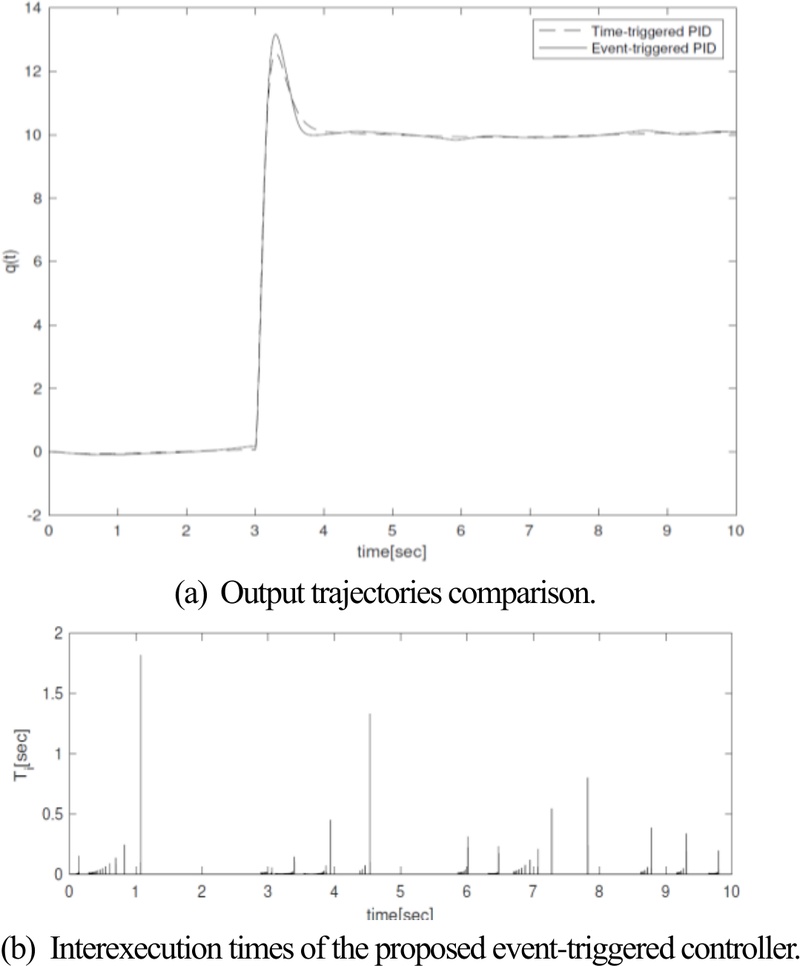
Simulation results.

Comparison of the number of control input updates.
V. CONCLUSIONS
We have proposed an event-triggered ϵ-PID controller for the position control of a DC motor. We have newly designed a triggering condition to cope with the event-triggering mechanism and presented a system analysis to show that the controlled system is well bounded. Our proposed controller retains the intrinsic merit of the event-triggered control method, that is the number of control input updates is significantly reduced. Via simulation results, we have shown that our proposed controller yields the similar control performance to the time-triggered controller while using much less control input updates.
Acknowledgments
This work was supported by the National Research Foundation of Korea (NRF) grant funded by the Korea government (MSIT) (No. 2023R1A2C1002832).
REFERENCES
-
H.-L. Choi, Y.-H. Chang, Y. Oh, and J.-T. Lim, “On robust position control of dc motors by ϵ-PID controller and its application to humanoid robot arms,” Proceeding of the 17th World Congress, IFAC, COEX, Seoul, Korea, pp. 14449–14453, July 6-11, 2008.
[https://doi.org/10.3182/20080706-5-KR-1001.02448]

-
D. Liu and G.-H. Yang, “Event-triggered non-fragile control for linear systems with actuator saturation and disturbances,” Information Sciences, vol. 429, pp. 1–11, 2018.
[https://doi.org/10.1016/j.ins.2017.11.003]
-
Y. Niu and Q. Ling, “Event-triggered sliding mode control for networked linear systems,” Journal of the Franklin Institute, vol. 360, no. 3, pp. 1978–1999, 2023.
[https://doi.org/10.1016/j.jfranklin.2022.12.055]
-
C. Peng and F. Li, “A survey on recent advances in event-triggered communication and control,” Information Sciences, vol. 457-458, pp. 113–125, 2018.
[https://doi.org/10.1016/j.ins.2018.04.055]
-
X. Li, Y. Tang, and H. R. Karimi, “Consensus of multi-agent systems via fully distributed event-triggered control,” Automatica, vol. 116, p. 108898, 2020.
[https://doi.org/10.1016/j.automatica.2020.108898]
-
F. Mazenc, M. Malisoff, and C. Barbalata, “Event-triggered control for continuous-time linear systems with a delay in the input,” Systems and Control Letters, vol. 159, p. 105075, 2022.
[https://doi.org/10.1016/j.sysconle.2021.105075]
-
J. A. Vazquez Trejo, D. Rotondo, M. A. Medina, and D. Theilliol, “Observer-based event-triggered model reference control for multi-agent systems,” 2020 International Conference on Unmanned Aircraft Systems (ICUAS), pp. 421–428, 2020.
[https://doi.org/10.1109/ICUAS48674.2020.9214050]
-
H.-L. Choi, “Pre-T event-triggered controller with a gain-scaling factor for a chain of integrators and its extension to a strict-feedback nonlinearity,”IEICE Transactions on Fundamentals, vol. E107. A , no. 9, pp. 1561-1564, 2024.
[https://doi.org/10.1587/transfun.2024EAL2030]
- H. K. Khalil, Nonlinear Systems, 3rd ed. Upper Saddle River, NJ 07458: Prentice Hall, 2002.
-
J. K. Hale and S. M. Verduyn Lunel, Introduction to Funcitonal Differential Equations. New York: Springer-Verlag, 1993.
[https://doi.org/10.1007/978-1-4612-4342-7]
-
Y.Jeong and J. Ban, “Event-triggered disturbance observer-based robust control for linear parameter varying systems,” Journal of Institute of Control, Robotics and Systems (in korean), vol. 29, no. 3, pp. 202-207, 2023.
[https://doi.org/10.5302/J.ICROS.2023.22.0190]
-
D.-M. Baek and H.-M. Joe, “DC Motor current control based on inverse model using recurrent neural network,” Journal of Institute of Control, Robotics and Systems (in korean), vol. 30, no. 1, pp. 27-32, 2024.
[https://doi.org/10.5302/J.ICROS.2024.23.0186]

received the B.S.E. degree in 2019 and M.S. degree in 2021 from the Department of electrical engineering, Dong-A university, Busan, Korea, respectively. She is currently working toward a Ph.D. degree. Her research interests are nonlinear control problems including robust controls, Quadrotor, Autonomous driving control.

received the B.S.E. degree from the department of electrical engineering, The Univ. of Iowa, USA in 1996, and M.S. degree in 1999 and Ph.D degree in 2004, from KAIST, respectively. Currently, he is a professor at department of electrical engineering, Dong-A university, Busan. His research interests are in the nonlinear control problems with emphasis on feedback linearization, gain scheduling, singular perturbation, output feedback, time-delay systems, time-optimal control. He is a senior member of IEEE.